Almond-Amaretto Cake with Salted Dulce de Leche Frosting
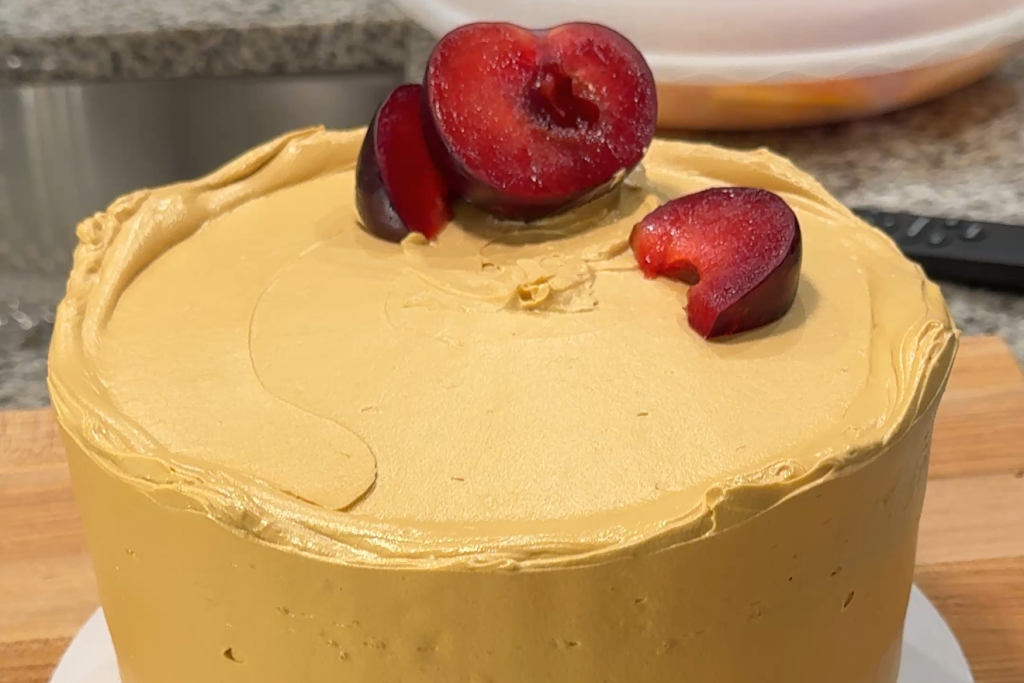
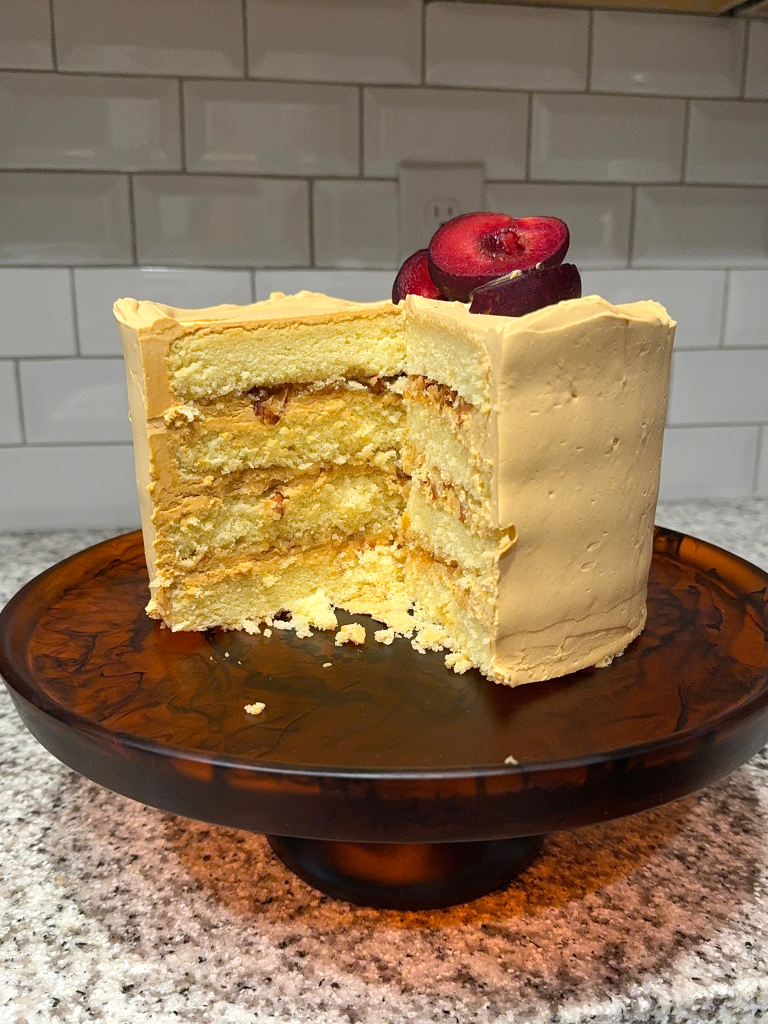
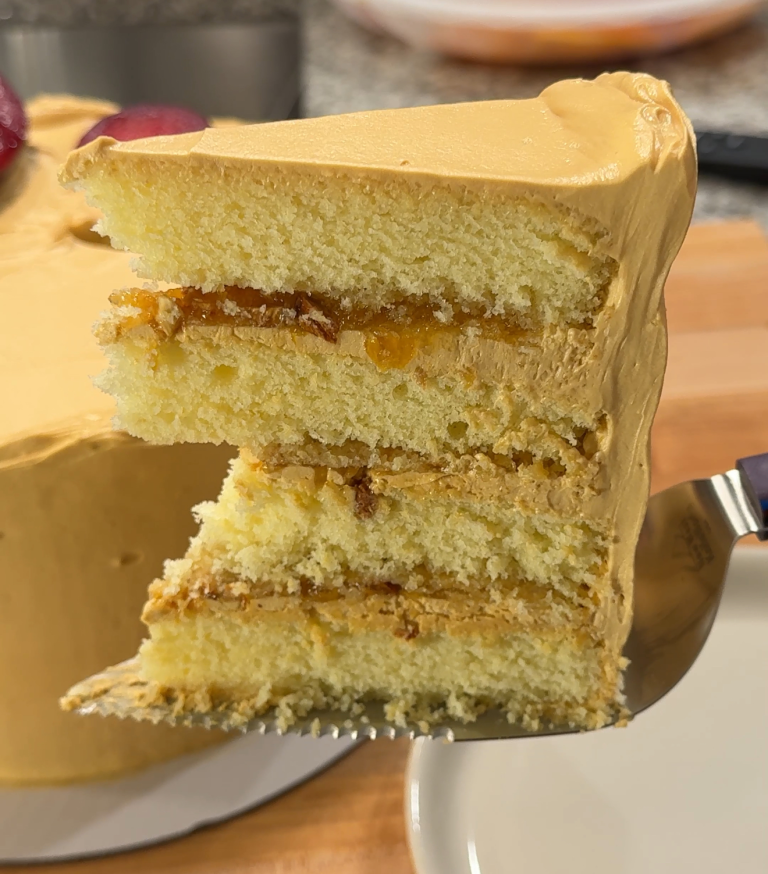
This reverse-creamed almond cake embraces an amaretto-apricot jam filling, crunchy almonds, and a salted dulce de leche Russian-style buttercream.
Servings: 24 servings
Equipment
- Digital kitchen scale
- Silicone spatula
- Stand mixer or hand mixer
- 2 large mixing bowls
- 2 8-Inch cake pans or 3 6-inch cake pans
Ingredients
Almond Cake Layers
- 330 grams white granulated sugar 1½ cups + 2½ tablespoons
- 280 grams cake flour 2½ cups
- 70 grams almond flour ½ cup + 2 tablespoons
- 3 grams table salt ½ teaspoon
- 12 grams baking powder 2.5 teaspoons
- 226 grams unsalted butter 1 cup, ½-inch cubes at room-temperature
- 250 grams eggs 5 large
- 240 grams unsweetened almond milk 1 cup
Amaretto-Apricot Filling
- 180 grams apricot jam 1/2 cup + 2 tablespoons
- 45 grams amaretto liqueur 3 tablespoons
Crunchy
- 60 grams roughly chopped roasted almonds ½ cup, Note #1
Salted Dulce de Leche Buttercream
- 388 grams salted American-style butter room-temperature (1¾ cups, Note #3)
- 380 grams dulce de leche I use one 380-gram can of Nestle
Instructions
Cake Method
- Position an oven rack at the center of the oven. Preheat the oven to 330°F / 170°C. Grease and flour two 8-inch cake pans (or three 6-inch cake pans) or spray them with baking spray. You may use a round parchment liner in the pan, if desired.
- Fit a stand mixer with the paddle attachment. Add the following ingredients to the stand mixer bowl: sugar, cake flour, almond flour, salt, and baking powder, and unsalted butter cubes. Mix on the lowest speed for 1 minute. Stop the mixer, scrape the sides of the bowl and the paddle with a silicone spatula. Continue the mixer on the medium-low speed (3 on a KitchenAid) for 2 minutes. The mixture will first look sandy, then start to clump like short crust, and finally come together like a soft cookie dough.
- Turn the mixer to just below medium speed (4 on a KitchenAid) and add one egg. Let the mixer go for 30 seconds or until the egg is completely mixed into the batter. Repeat for each egg.
- Stop the mixer and scrape the bowl. Turn the mixer to medium-low speed (3 on a KitchenAid) and slowly pour in the unsweetened almond milk. Pouring the almond milk should take about 90 seconds. Once the milk is all added, stop the mixer and scrape the bowl. Set the mixer to medium speed (5 on KitchenAid) and let it run for one minute. The batter should look aerated yet slightly “grainy.” It will also feel fluffy when mixed with a spatula.
- Using a digital kitchen scale for accuracy, split the batter evenly between the greased and floured cake pans. For two 8-inch pans, each should have about 695-705 grams of batter. For three 6-inch pans, each pan should hold around 470 grams. Use an offset spatula (or whatever you’ve got!) to smooth the top of the batter in the cake pans.
- Place the pans on the center (middle) oven rack. For 6-inch pans, set a timer for 45 minutes. For 8-inch pans, set a timer for 50 minutes. When finished, a toothpick should come out with crumbs when inserted in the middle. If there is still batter on the toothpick, bake for an additional 3-5 minutes and check again.
- Turn off the oven, and remove the cake pans from the oven. Let the cake layers rest in the pans for 10-15 minutes. Release the cake layers onto plastic wrap. Wrap the layers completely but not too tightly. Allow them to rest on the counter, in the refrigerator, or in the freezer until completely cooled.
Jam Filling Method
- In a small bowl, use a spoon to mix the apricot jam and amaretto liqueur until fully combined.
Frosting Method
- Add the room-temperature unsalted butter to the bowl of a stand mixer fitted with a paddle attachment. Beat on medium speed (5 on KitchenAid) for 3 minutes. Scrape the sides of the bowl. Continue the mixer on medium speed for 2 minutes longer.
- Stop the mixer and scrape the sides of the bowl. The butter should be pale and starting to “fluff.” Add the dulce de leche. Beat the mixture just above medium speed (6 on KitchenAid) for 1 minute. Scrape the sides of the bowl. Add the salt. Beat for an additional 3 minutes just above medium speed. Scrape the bowl. Beat for 1 minute just above medium speed.
- This recipe yields about 3 cups of Russian-style buttercream. Assemble the cake and use leftover frosting for decoration, if desired.
Summary of Assembly
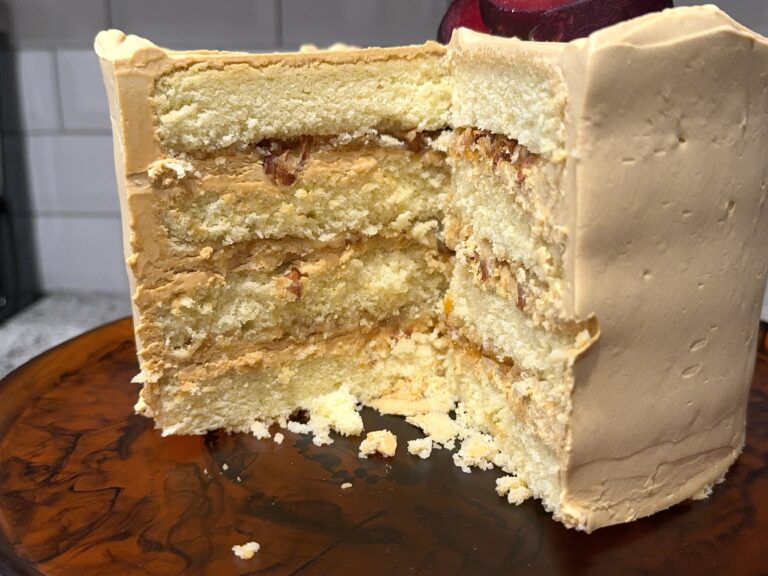
- Cut room-temperature cake layers in half so you have 4 even layers.
- Layer the cake in the following order: cake, ½ cup buttercream, ¼ cup jam, sprinkle of almonds, cake, ½ cup buttercream, ¼ cup jam, sprinkle of almonds, cake, ½ cup buttercream, ¼ cup jam, sprinkle of almonds, cake. You will use all the jam, but you’ll still have about 1½ cup of frosting left. And you can dice up more almonds for decoration, if desired.
- Frost the exterior. You can crumb coat if desired, but I didn't when I made it. Place the cake in the freezer for about 10 minutes.
- Garnish with more chopped roasted almonds or top with fresh stone fruit, like apricot or aprium (aka plumcot).
- Slice and enjoy with a glass of milk or a scoop of vanilla ice cream.
Notes
Notes:
- To roast the almonds, place them on a sheet tray and bake for 15 minutes in an oven preheated to 350°F.
- If whipping by hand, you may need to use a wooden spoon to cream the butter with the dry ingredients.
- Compared to European-style butters, American-style butter contains less butterfat and a bit more water. Any generic brand or popular lower-cost American brand will do: Land O'Lakes, Challenge, Organic Valley, etc. The butter should contain 80% butterfat, unlike European, which contains 82% or more. You can use European butters in this recipe — the frosting will be stiffer but still smooth.